Growing Mangoes in a Greenhouse or Outdoors? 7 Key Points to Help You Choose
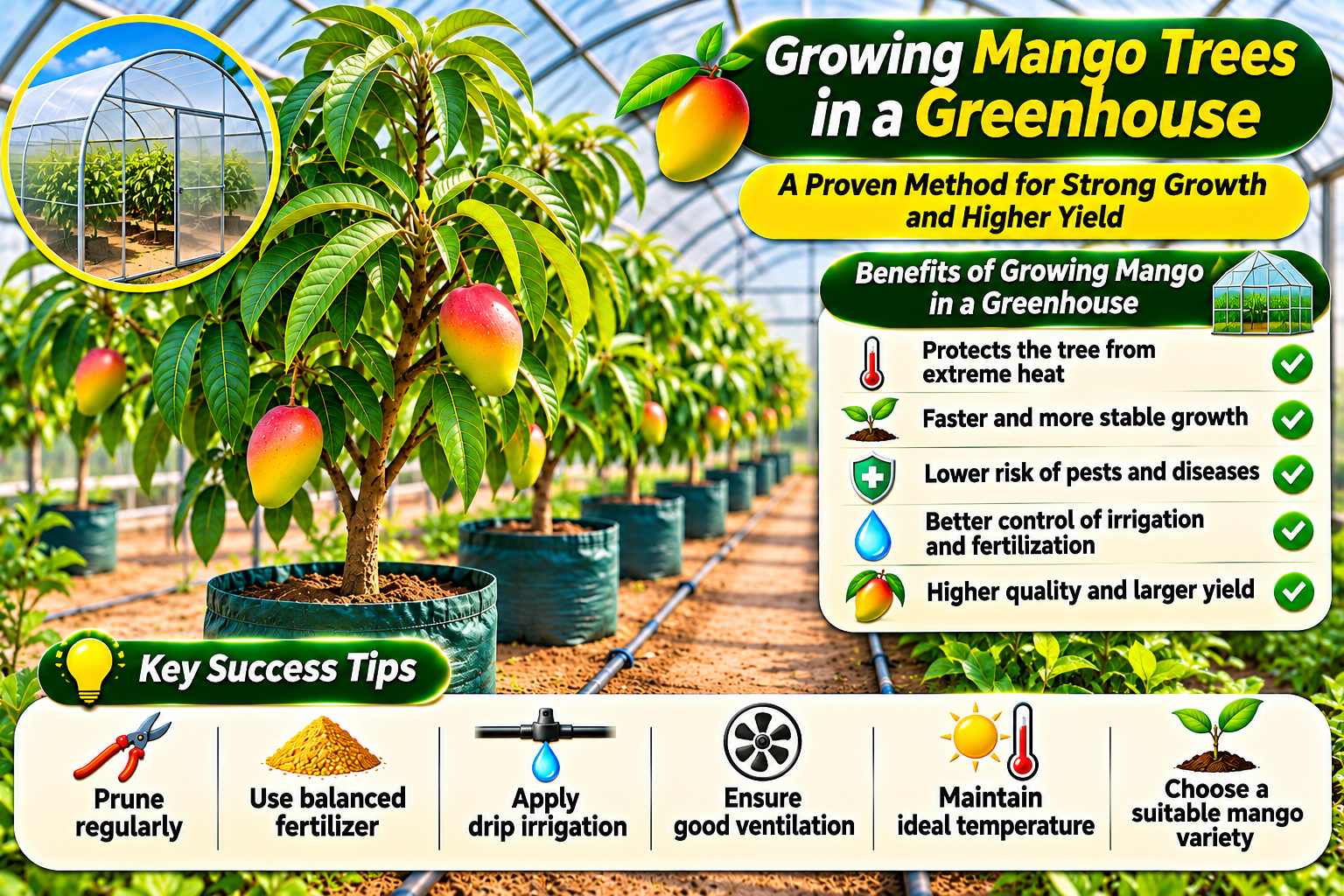
Do your mango trees need a greenhouse in your garden or farm, or can outdoor cultivation with suitable preparations achieve your goals? Before deciding on growing mangoes in a greenhouse, it is important to assess your purpose, site conditions, expected tree size, and ability to manage and monitor the structure. Choosing greenhouse mango cultivation is not simply a matter of selecting a covering material; it depends on the trees' requirements and the surrounding growing conditions.
Agricultural protection systems serve different purposes and can be useful in specific circumstances, but no single system is suitable for every location. Comparing greenhouse mango cultivation with outdoor growing can help you identify the most appropriate option before investing in permanent structures, while taking into account the needs of mango trees in the UAE climate and consulting a specialist when necessary.
1. Understanding the Difference Between Greenhouses, Shade Structures, and Protective Nets
A greenhouse is a structure that covers a growing area with materials such as plastic or other types of covering, with the aim of influencing the conditions surrounding plants and controlling certain environmental factors. Choosing a greenhouse mango growing system requires careful consideration of ventilation, temperature and humidity management, and the type of covering material.
A shade structure is a way to reduce some of the direct sunlight reaching plants. It does not necessarily create an enclosed environment or provide full climate control. Shade netting is used to provide a certain level of shade, while other types of netting may be used to protect plants from birds, insects, or wind, depending on their specifications and intended use.
It is important to distinguish these systems from temporarily covering a sapling during a period of harsh weather. Temporary protection for a young plant does not necessarily mean that the tree will require a permanent structure as it matures and enters the fruit-bearing stage. This distinction is important when planning a greenhouse mango growing project, because the needs of young saplings are not the same as those of mature, fruit-bearing trees. The purpose of the covering should also be clearly defined before choosing a greenhouse or opting for localized protection instead.
2. What Is Your Mango-Growing Objective?
Before choosing between growing mangoes in a greenhouse and outdoor cultivation, identify the stage of growth and the results you want to achieve:
A small home-growing project: Outdoor cultivation may be suitable if the location provides appropriate growing conditions, sufficient space, and regular care. Localized shading can also be considered when there is a clear need.
Growing trees in a garden: Consider the trees' mature size, canopy spread, and accessibility for routine care. Avoid selecting a structure based only on the current size of the seedlings.
A commercial growing project: The decision requires an agricultural and financial assessment covering the number of trees, mango variety, management approach, pollination requirements, and necessary equipment. In this case, the feasibility of greenhouse mango cultivation should be compared with outdoor production.Holding seedlings before sale or planting: The requirements at this stage differ from those of mature fruit-bearing trees. Recommendations for seedling nurseries should not automatically be applied to an established mango orchard.
Holding Saplings Before Sale or Planting: The requirements at this stage differ from those of mature, fruit-bearing trees. Therefore, recommendations for nursery saplings should not automatically be applied to a mango orchard.
Therefore, the decision to grow mangoes in a greenhouse should be based on the project's actual objectives rather than simply the desire to use an advanced agricultural structure. Define the intended growing stage first, as the requirements for greenhouse mango cultivation for fruit production differ from those involved in protecting young seedlings.
3. What Should You Assess in an Outdoor Growing Site?
Choosing outdoor cultivation does not mean leaving the trees without proper planning. Start by assessing the available space, sun exposure, prevailing wind directions, soil conditions, water drainage, and access to a suitable irrigation source. You should also consider how easily the trees can be reached for monitoring, inspection, and routine care.
Consider the following questions: Are there buildings or walls that affect sunlight exposure? Is there enough room for the tree canopies to expand as they mature? Can the trees be monitored regularly during periods of high temperatures?
In the UAE, it should not be assumed that every outdoor growing site requires a greenhouse. Conditions vary from one location to another, and the needs of young seedlings differ from those of established trees. Improving site selection or considering a suitable shading option may be more practical than constructing an entire greenhouse.
It is also important not to view growing mangoes in a greenhouse as an automatic solution to site-related challenges. Addressing soil conditions or improving tree spacing may be more relevant to the project's needs than building a complete structure.
4. What Should You Assess Before Choosing a Greenhouse?
Before requesting a quotation, discuss the proposed structure with a specialist and confirm whether its design is suitable for mango trees. Do not rely solely on the system's name or the type of covering. Ask about the structure's design, height, ventilation system, temperature and humidity management, and whether the available space can accommodate mature trees.
When considering growing mangoes in a greenhouse, also review access to the trees and equipment, as well as the structure's operating, maintenance, and monitoring requirements. A greenhouse is not simply a structure that is installed and then left unattended. It requires ongoing management, and inadequate ventilation or an unsuitable covering may create conditions that are not appropriate for tree growth.
Ask the supplier to clarify exactly what the quotation includes and excludes, such as the structure, covering, ventilation, additional equipment, operating expenses, and maintenance. Avoid relying on general dimensions or specifications from another project without assessing your own site's conditions.
Also, ask whether the design is suitable for the selected mango variety and its growth characteristics, and whether routine care and monitoring can be carried out داخل the structure. The success of growing mangoes in a greenhouse depends on how well the system accommodates the trees over the long term, not simply on how easily the structure can be built initially.
5. A Practical Comparison Between the Two Systems
| Comparison factor | Outdoor cultivation | Greenhouse cultivation | What should you assess? |
|---|
| Initial setup | Site preparation and standard growing requirements | Structure, covering, and design-related equipment | What does each option actually require? |
| Monitoring | Monitoring weather, soil, and tree conditions | Monitoring trees and conditions inside the structure | Who will be responsible for monitoring? |
| Space | Depends on tree spacing and future canopy growth | Depends on the structure's area, height, and expansion potential | Can it accommodate mature trees? |
| Ventilation and temperature | Influenced by site conditions and weather | Influenced by the design, covering, and ventilation management | How will temperature and ventilation be managed? |
| MaintenanceRoutine care of the site and trees | Site and Tree Care Activities | Tree care plus maintenance of the structure's components | What regular tasks will be required? |
| Costs | Site preparation, irrigation, and growing supplies | Site preparation, irrigation, and growing supplies | What does the quotation cover, including recurring expenses? |
The table does not identify an absolute winner; instead, it highlights the factors that should be compared. The outcome may vary depending on the location, purpose, and project size, so it is not possible to determine the most suitable option without assessing the actual growing conditions. This comparison helps evaluate the feasibility of growing mangoes in a greenhouse, rather than making a decision based solely on appearance or the level of structural equipment.
When comparing the cost of growing mangoes in a greenhouse with open-field cultivation, do not consider only the initial construction costs. Also account for operating, maintenance, and monitoring expenses throughout the structure's service life.
6. Flowering and Pollination Inside Protected Structures
One important consideration when growing mangoes inside a protected structure is whether pollinating insects can reach the flowers. Mango trees benefit from the activity of various insects that transfer pollen, and the design or management of an enclosed structure may influence insect movement.
A study published in Scientia Horticulturae examined the role of hoverflies in mango pollination under protected cultivation conditions. This highlights that pollination management is an important part of planning such a system and should not be overlooked. However, the findings of a specific trial do not necessarily mean that the same approach will be suitable for every farm or mango variety.
Before adopting a greenhouse mango growing system, discuss with a specialist how pollinators can access the structure or be managed within it, and whether the ventilation and covering materials are suitable during the flowering period. Pollination should be included in the greenhouse mango growing plan from the design stage rather than postponed until flowers appear. You can also read the article Mango Flower Pollination and the Role of Beneficial Insects to better understand the role of insects in this process.
7. Common Mistakes When Making Your Decision
Several mistakes can increase expenses without achieving the intended results when planning greenhouse mango cultivation:
Assuming that any type of covering will automatically improve mango-growing conditions.
Purchasing a structure before defining the growing objective and intended production stage.
Choosing the design based on the sapling's current size rather than its expected mature size.
Transferring a climatic or agricultural practice from another region without assessing the differences in local conditions.
Overlooking ventilation, temperature, and pollination when evaluating the structure.
Expecting guaranteed yields or year-round production simply because a greenhouse is being used.
Ignoring operating and maintenance expenses when preparing a budget for greenhouse mango cultivation.
Another common mistake is choosing greenhouse mango cultivation without assessing whether the project has the resources to monitor and operate the structure. Selecting a system is not the final step; it also requires ongoing management and performance reviews.
Questions to Prepare Before Requesting a Quotation
Use the following checklist to organize the information a specialist needs before recommending greenhouse mango cultivation or outdoor growing:
Growing objective:
Location and Space
Planned number of trees:
Intended stage: seedlings or fruit-bearing trees?
Available or proposed mango varieties:
Water source:
Operating and maintenance requirements:
Person responsible for monitoring:
Missing Information Before Making a Decision:
The clearer the information, the easier it becomes to compare quotations on a consistent basis and determine whether a greenhouse is truly necessary or whether a simpler option would achieve the intended purpose. These details also help the specialist assess whether growing mangoes in a greenhouse is suitable for the site's conditions, rather than providing a general recommendation that does not account for the project's specific requirements.
Conclusion
Before investing in [**greenhouse mango cultivation**](https://pmc.ncbi.nlm.nih.gov/articles/PMC9782227/?utm\&utm_source=chatgpt.com), compare the available options and request an assessment tailored to your location rather than relying on another grower's experience or assuming that the most advanced system is always the best choice. Once you have identified the appropriate growing system, you can [browse the mango varieties available at Masfout Gardens](https://masfoutgardens.com/product-category//?utm_source=chatgpt.com) and inquire about the sapling specifications before placing your order.
**Before investing in [greenhouse mango cultivation](https://pmc.ncbi.nlm.nih.gov/articles/PMC9782227/?utm_source=chatgpt.com), compare the available options and seek an assessment based on your specific site conditions rather than relying on another project's experience or assuming that the most advanced system is always the best choice. Once you have identified the most suitable growing system, you can [browse the mango varieties available at Masfout Gardens](https://masfoutgardens.com/en/product-category//?trp-edit-translation=preview\&utm_source=chatgpt.com) and inquire about seedling specifications before placing an order.**[image](https://www.google.com/s2/favicons?domain=https://pmc.ncbi.nlm.nih.gov\&sz=32)PubMed Central (PMC)+1